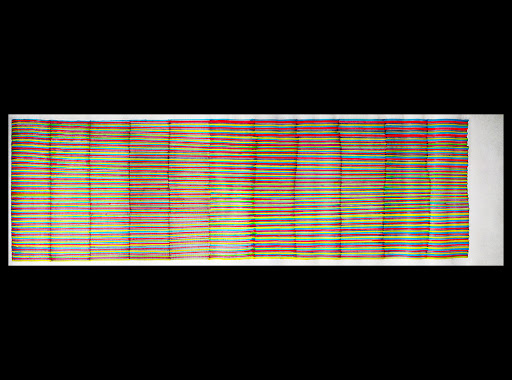
Serial Drawing (500 yellow, 500 gray, 500 red and 500 blue lines, within a area of 1 square meter. All lines must be between 10 cm. and 20 cm. long and straight)
(as in Nov.28, 2013)
Fibre-tip colour pen on rice paper
213 x 38 cm (in a roll)
(ongoing)
[”Sol Lewitt. Pasadena Art Museum, November 17 – January 3, 1971:
The draftsman and the wall enter a dialogue. The draftsman becomes bored but later through this meaningless activity finds peace or misery. The lines on the wall are the residue of this process. Each line is as important as each other line. All the lines become one thing. The viewer of the lines can see only lines on a wall. They are meaningless. That is art. (From Pasadena catalogue.)
The artist conceives and plans the wall drawing. It is realized by the draftsmen. (The artist can act as his own draftsman.) The plan, written, spoken or a drawing, is interpreted by the draftsman.
There are decisions which the draftsman makes, within the plan, as part of the plan. each individual, being unique, given the same instructions would carry them out differently.
The artist must allow various interpretations of his plan. The draftsman perceives the artist’s plan, then reorders his own experience and understanding.
The draftsman’s contributions are unforeseen by the artist, even if he, is the draftsman. Even if the same draftsman followed the same plan twice, there would be two different works of art. No one can do the same thing twice.
The artist and the draftsman become collaborators in making the art.
Each person draws a line differently and each person understands words differently.
Neither lines nor words are ideas. They are mean by which ideas are conveyed.”
(in Lippard, Lucy R. Six Years: The Dematerialization of the Art Object from 1966 to 1972 … Berkeley: University of California Press, 1973. p. 200)]
 hernanigil.com